
EN S355JR Structural Steel Bulk for Latin America Infrastructure
Having a Mill Test Certificate is not enough to clear customs in Latin America.
The core requirement for importing EN S355JR structural steel bulk into markets like Brazil, Chile, and Mexico is the alignment of the EN10025-2 Declaration of Conformity with the specific impact toughness grade required by local seismic or climatic conditions. Most clearance delays stem from a mismatch between the declared JR grade and the actual low-temperature performance data required for high-altitude or southern latitude projects, rather than tariff disputes.
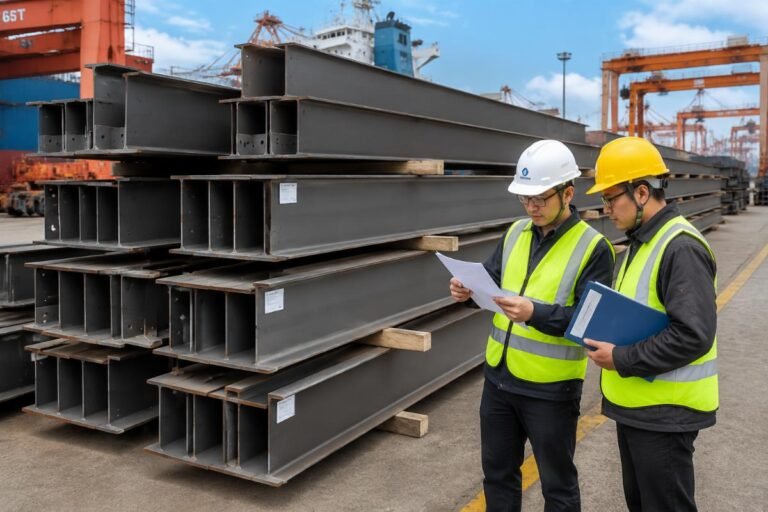
Walking the floor of a rolling mill in Jinan, the difference between a standard plate and one destined for a complex international project is often invisible to the naked eye. The chemistry looks the same. The surface finish appears identical. Yet, the paperwork trail determines whether that steel sits in a warehouse or becomes part of a bridge. In the early days of handling exports, a shipment of H-beams bound for a mining storage facility in Antofagasta, Chile, was held at the port of Valparaiso. The issue was not the quality of the steel, but the absence of specific impact energy test results in the certification package. The client had ordered S355JR, assuming its general applicability, but the local engineering specifications for that altitude required verified toughness at lower temperatures. The cargo remained stuck while we scrambled to provide third-party verification, costing time and credibility. This experience reshaped the approach to EN S355JR structural steel bulk procurement: technical compliance must precede logistical execution.
Why EN S355JR is the Preferred Choice for Latin American Infrastructure?
The selection of structural steel for large-scale infrastructure in Latin America often hinges on the balance between mechanical strength and weldability. EN S355JR offers a yield strength of 355 MPa, which provides a robust safety margin for heavy-load applications such as industrial warehouses, port expansions, and mining support structures. Unlike some regional standards that may vary in their chemical composition limits, the EN10025-2 standard provides a consistent framework recognized by major engineering firms across the continent.
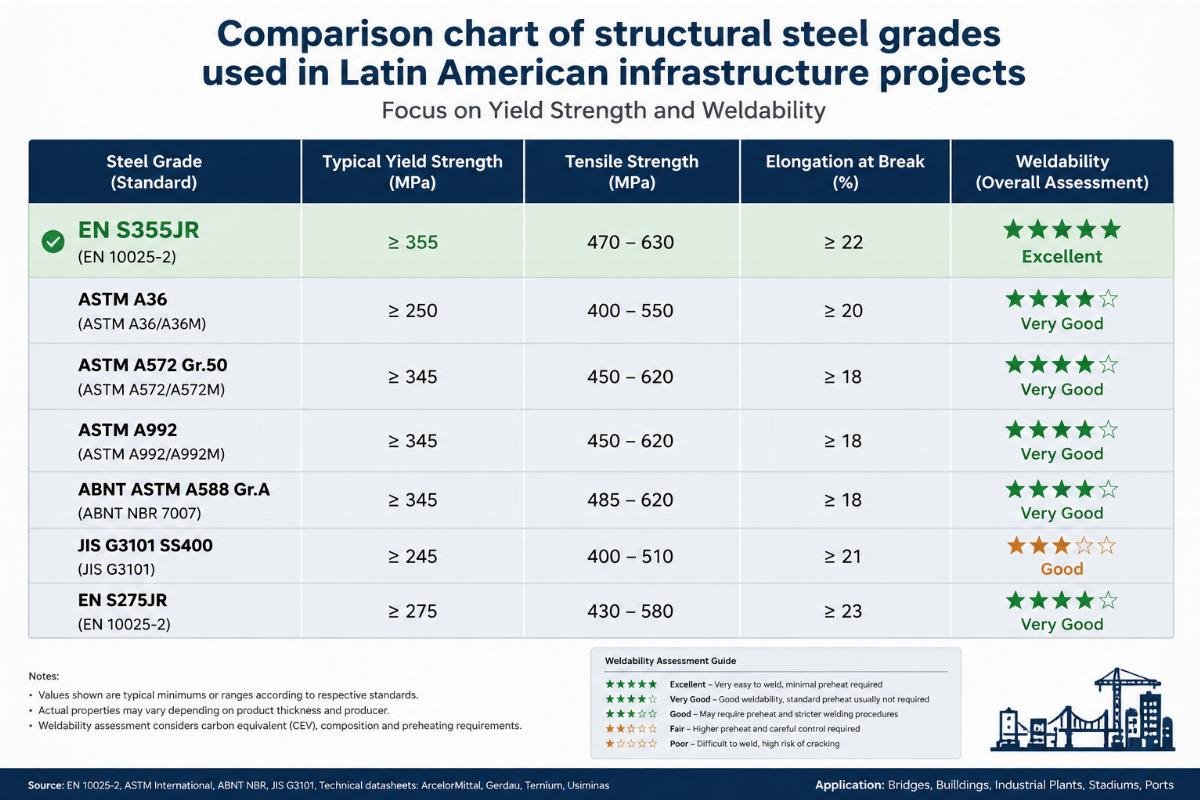
The preference for this grade is not merely about raw power. It is about the predictability of its behavior during fabrication. In regions where skilled labor may vary in availability, a steel grade that tolerates standard welding procedures without extensive pre-heating reduces the risk of on-site defects. For EPC contractors managing tight schedules, the ability to cut, drill, and weld EN S355JR structural steel bulk without specialized thermal treatments translates directly into faster assembly times. However, this advantage is only realized if the material truly meets the European norm. Counterfeit or mislabeled products that claim compliance but lack the rigorous testing behind the EN designation can lead to catastrophic failures in load-bearing joints. [NEED_CITE: common failure modes in non-compliant structural steel imports]
A frequent misconception is that any high-strength steel can substitute for S355JR. In reality, the carbon equivalent value of S355JR is optimized to prevent cracking in the heat-affected zone during welding. When sourcing EN S355JR structural steel bulk, buyers must verify that the manufacturer’s production process controls this parameter strictly. A supplier that cannot provide detailed chemical analysis reports alongside the mechanical properties is likely cutting corners. The reliability of the supply chain depends on this transparency. For projects in seismic zones, such as parts of Chile and Mexico, the ductility provided by this grade allows structures to absorb energy during earthquakes without brittle fracture, making it a safer choice than higher-carbon alternatives that might offer similar static strength but poor dynamic performance.
Critical Technical Specs: JR vs J0 vs J2 Impact Grades
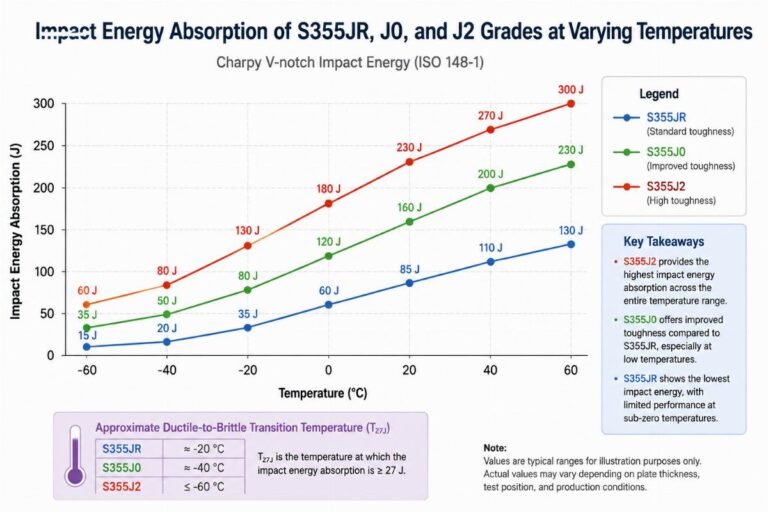
The suffix in the steel grade designation is not a minor detail; it defines the material’s behavior under stress at specific temperatures. S355JR is tested for impact resistance at room temperature, typically +20°C. This is sufficient for many low-altitude, tropical applications in northern Brazil or coastal Mexico. However, Latin America’s geography is diverse. Projects in the Andes mountains or southern Chile face significantly lower ambient temperatures. Using JR grade steel in these environments risks brittle fracture, where the steel snaps rather than bends under load.
| Grade | Impact Test Temperature | Typical Application Context | Risk in Cold Climates |
|---|---|---|---|
| S355JR | +20°C | Low-altitude warehouses, tropical infrastructure | High risk of brittle fracture |
| S355J0 | 0°C | Moderate altitude structures, seasonal cold regions | Moderate risk, requires verification |
| S355J2 | -20°C | High-altitude mining, southern latitude projects | Low risk, suitable for extreme cold |
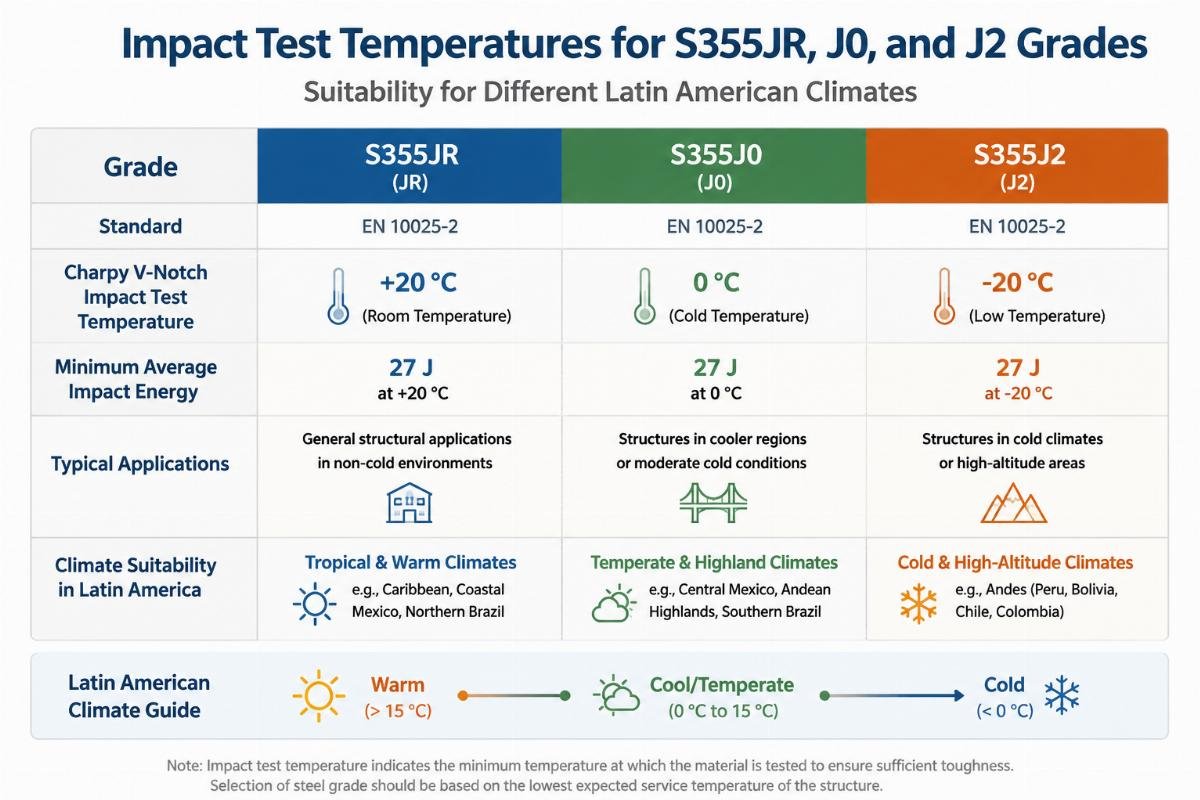
A case in point involves a port expansion project in southern Brazil. The initial specification called for S355JR due to cost considerations. However, during the winter months, nighttime temperatures dropped close to freezing. The engineering team realized that the impact energy requirements for the crane runways were not met by the JR grade. Switching to S355J0 or J2 would have ensured safety, but the material had already been ordered. The solution involved rigorous additional testing and restricted usage areas, which delayed the project. This highlights the importance of selecting the correct impact grade from the outset. When purchasing EN S355JR structural steel bulk, it is crucial to confirm whether the project location demands a higher grade like J0 or J2. [NEED_CITE: EN10025-2 impact testing standards and temperature requirements]
Manufacturers who specialize in EN-standard production will have the capability to produce J0 and J2 grades on request. The difference lies in the controlled cooling process and stricter chemical composition limits, particularly regarding phosphorus and sulfur content. These elements affect the steel’s toughness. A supplier that treats all S355 variants as identical is a red flag. Buyers should request sample test reports for the specific batch to ensure the impact values meet the required threshold. For EN S355JR structural steel bulk orders, clarifying the end-use environment prevents costly mid-project changes. The marginal increase in cost for J2 grade is negligible compared to the potential expense of structural failure or replacement.
Common Pitfalls in Documentation & Customs Clearance
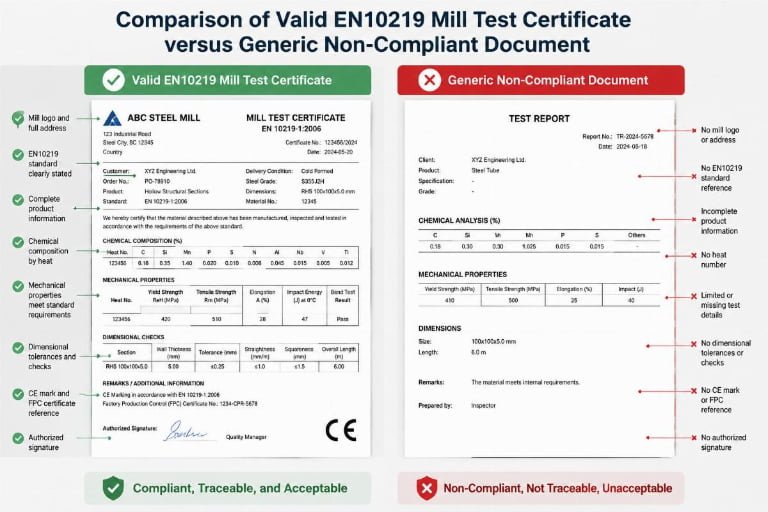
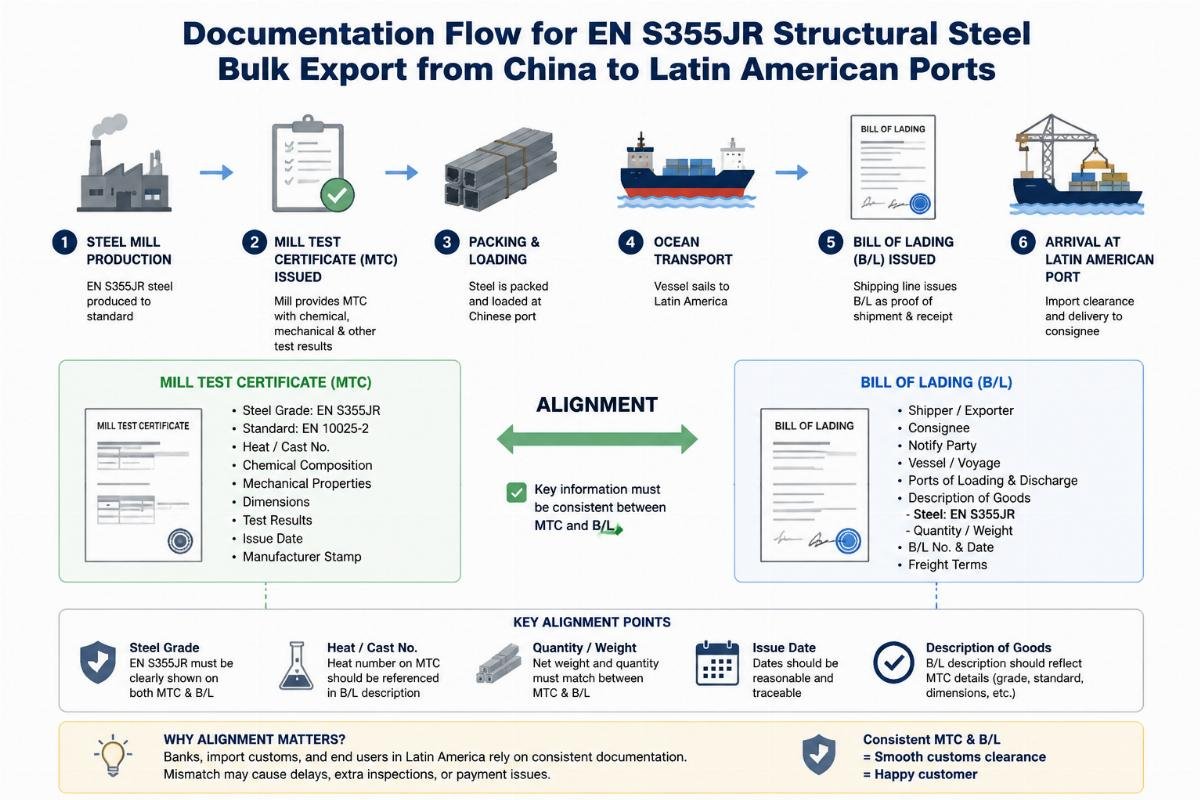
Customs authorities in Latin America are increasingly stringent regarding the documentation of imported steel. A common pitfall is assuming that a generic Mill Test Certificate (MTC) is sufficient. In reality, many countries require a specific Declaration of Conformity (DoC) that explicitly references EN10025-2. This document must match the details on the Bill of Lading and the commercial invoice exactly. Discrepancies in weight, grade, or heat numbers can trigger inspections that last for weeks.
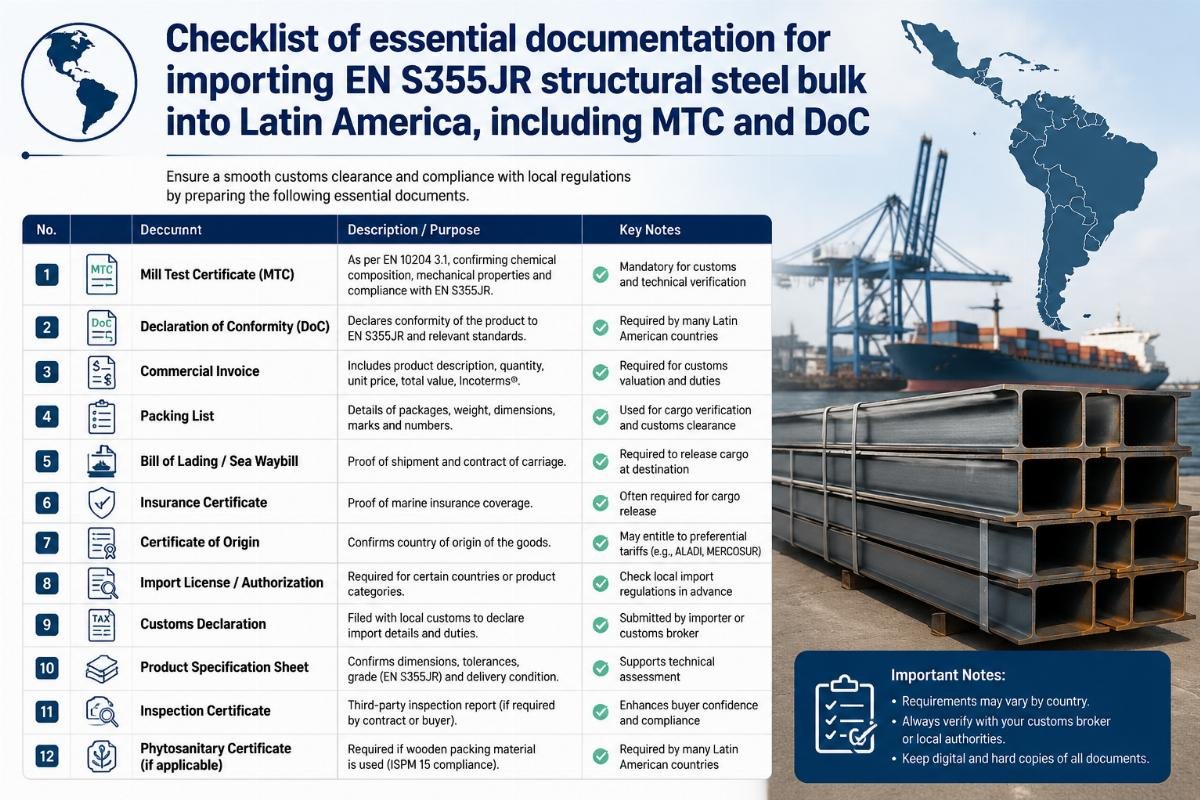
In Mexico, for instance, importers have faced issues when using domestic standards like NMX to describe European-grade steel. The customs system may not recognize the equivalence without proper certification from an accredited body. Similarly, in Brazil, the import license process requires precise classification under the Harmonized System (HS) code. Misclassifying structural beams as general iron products can lead to incorrect duty assessments and penalties. The key is consistency. Every document must tell the same story. The MTC should list the chemical composition and mechanical properties, including the impact test results if applicable. If the steel is S355JR, the certificate must state that it meets the +20°C impact requirement. If it is J2, the -20°C result must be visible.
Another frequent error is the lack of traceability. Each bundle of steel should be marked with the heat number, which corresponds to the MTC. During customs inspection, officers may check these marks. If the marks are faded, missing, or do not match the paperwork, the entire shipment can be rejected. For EN S355JR structural steel bulk, ensuring that the marking is durable and legible after ocean transit is essential. Some suppliers use paint markers that wash off in humid conditions. Using stamped or etched marks provides a permanent record. [NEED_CITE: Latin American customs regulations for steel imports]
Buyers should also be wary of suppliers who provide “typical” values instead of “actual” test results. EN standards require actual values for each heat. A certificate that lists average properties for a month’s production is not compliant. This distinction is critical for liability purposes. If a structural failure occurs, the project owner will need to prove that the specific steel used met the standard. Only actual test reports provide this proof. When negotiating for EN S355JR structural steel bulk, insist on receiving draft certificates for approval before shipment. This allows time to correct any errors before the goods leave the factory.
Logistics Optimization for Bulk Structural Steel
Shipping structural steel efficiently requires more than just filling a container. It involves strategic planning to maximize space utilization while minimizing the risk of damage. H-beams, plates, and angles have different shapes and weights. Mixing them in a single container can optimize freight costs, but it requires careful loading plans. Heavy items must be placed at the bottom, with lighter, more fragile items on top. Proper dunnage and bracing are essential to prevent movement during the rough seas of the Pacific or Atlantic crossings.
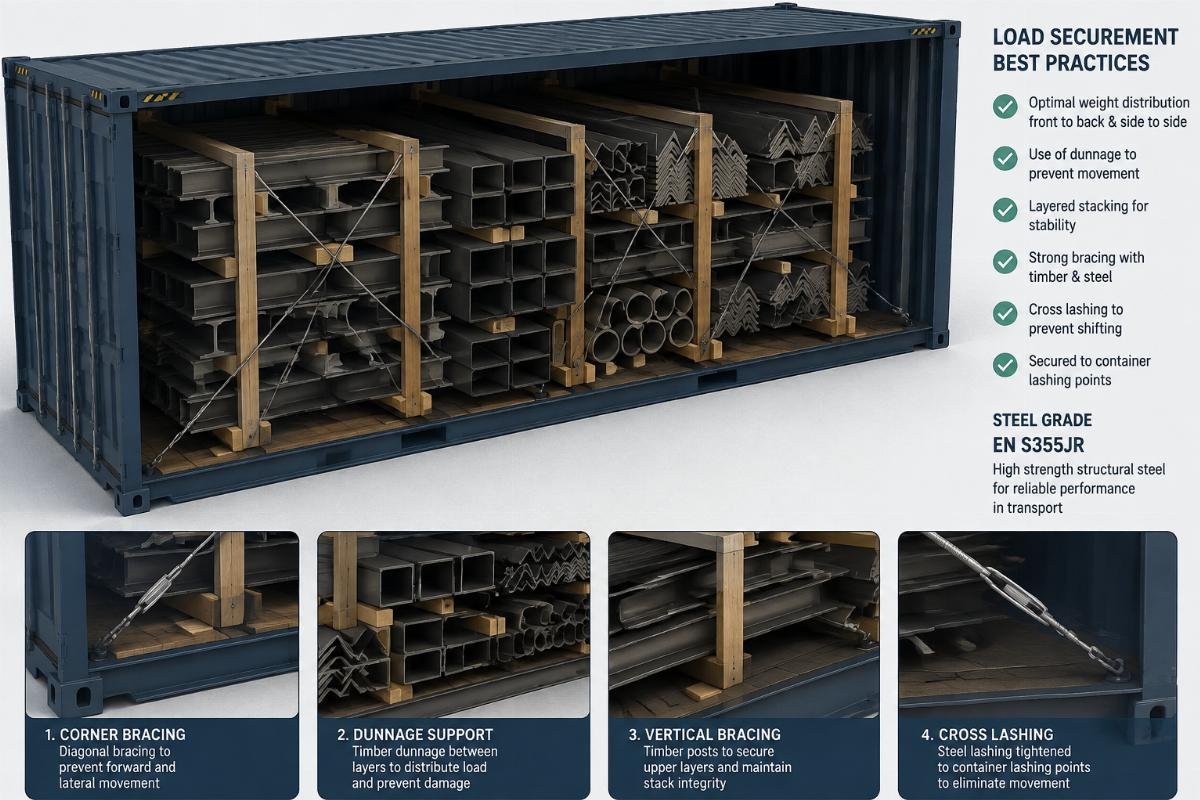
A notable example involved a shipment to a construction site in Peru. The supplier loaded H-beams and steel plates together without adequate separation. During transit, the sharp edges of the plates cut into the protective coating of the beams. Upon arrival, the beams required extensive re-blasting and repainting, adding significant cost and delay. This could have been avoided with simple wooden spacers and proper securing. For EN S355JR structural steel bulk, the packaging method is as important as the steel itself. Shot-blasted and painted steel needs extra care to preserve the finish. Galvanized steel is more resilient but still susceptible to white rust if trapped moisture is not allowed to escape.
Calculating the volume-to-weight ratio is crucial. Steel is dense, so containers often reach weight limits before volume limits. However, long beams may require open-top containers or flat racks if they exceed standard container dimensions. Understanding the local infrastructure at the destination port is also vital. Some ports in Latin America have limited crane capacity or handling equipment for oversized loads. Coordinating with the freight forwarder to ensure the chosen packaging matches the port’s capabilities prevents bottlenecks. [NEED_CITE: best practices for shipping structural steel to emerging markets]
Furthermore, insurance coverage should specifically address handling damage. Standard marine insurance may not cover damage caused by improper loading. Buyers should verify that the supplier’s loading procedure follows international standards. Requesting photos of the loaded container before sealing provides evidence of proper stowage. This practice has proven effective in resolving disputes when damage occurs. For large orders of EN S355JR structural steel bulk, working with a manufacturer that has experience in mixed-loading optimization can reduce the overall landed cost. The ability to consolidate different profiles into fewer containers simplifies logistics and reduces the carbon footprint of the project.
Conclusion
Procuring EN S355JR structural steel bulk for Latin America requires a dual focus on technical compliance and logistical precision. Success depends on verifying the correct impact grade for the specific climate, ensuring documentation aligns perfectly with customs requirements, and optimizing packaging to prevent transit damage. By prioritizing these elements, buyers can avoid costly delays and ensure the structural integrity of their infrastructure projects.