
S355J0/JR/J2 Structural Steel: EN-Certified Manufacturer & Supplier
S355J0, JR, and J2 share the same yield strength but differ critically in impact toughness temperature requirements.
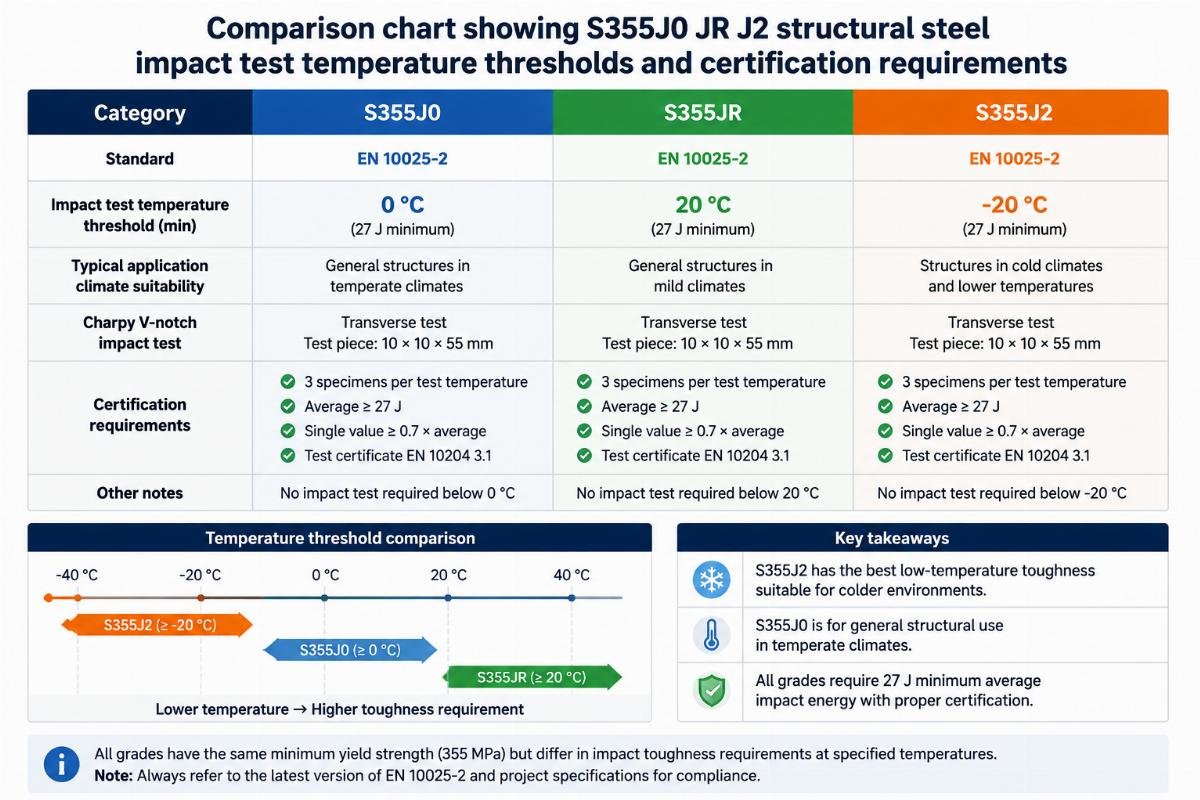
Selecting the wrong suffix grade does not merely result in a paperwork discrepancy; it creates a structural vulnerability in dynamic or low-temperature environments and triggers customs detention due to certificate mismatches. The core distinction lies in the mandatory Charpy V-notch impact test temperatures: JR at room temperature, J0 at 0°C, and J2 at -20°C. Buyers must verify that the Mill Test Certificate (MTC) explicitly lists impact energy values corresponding to these specific thresholds, rather than assuming interchangeability based on tensile strength alone. [NEED_CITE: EN 10025-2 impact testing temperature definitions]
Understanding these nuances prevents costly logistical delays and ensures compliance with engineering specifications for infrastructure projects across varying climatic zones.
What Do J0, JR, and J2 Actually Mean in S355 Steel?
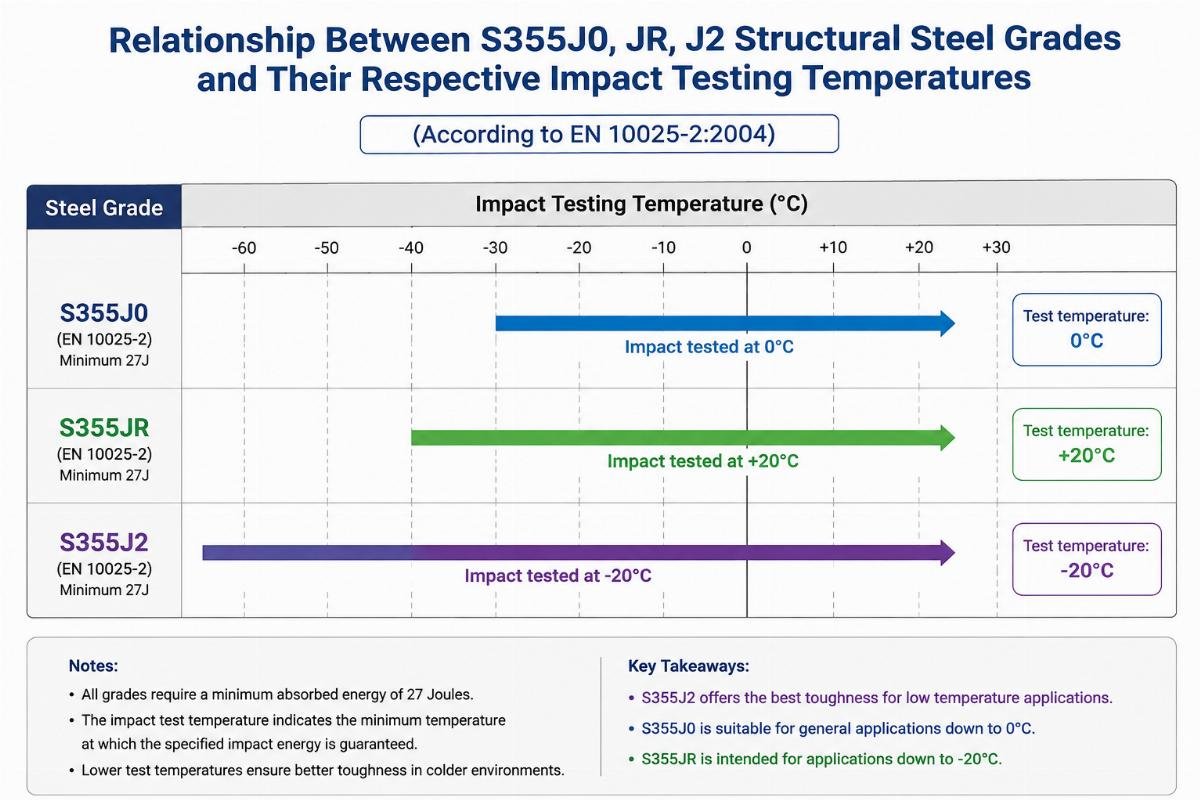
The alphanumeric suffixes in S355J0 JR J2 structural steel are not arbitrary marketing labels; they define the minimum ambient temperature at which the material must maintain specified impact resistance. While the “S355” prefix indicates a minimum yield strength of 355 MPa for thicknesses up to 16mm, the suffixes dictate the steel’s behavior under sudden shock loads.
JR denotes that the material has been tested for impact toughness at +20°C (room temperature). This is the standard baseline for general structural applications in temperate climates where freezing conditions are rare. J0 raises the bar, requiring successful impact testing at 0°C. This grade is often specified for structures exposed to seasonal freezing or moderate cold environments. J2 represents a higher tier of toughness, mandating verification at -20°C. This is critical for high-latitude projects, offshore structures, or any application where brittle fracture risks increase due to low ambient temperatures. [NEED_CITE: Charpy V-notch test standards per EN ISO 148-1]
Misinterpreting these codes as mere quality tiers rather than temperature-specific performance metrics leads to specification errors. A beam that performs adequately in a warehouse in Southern Europe may become dangerously brittle if installed in a Nordic bridge project without the correct J2 certification.
Critical Differences: Impact Toughness vs. Yield Strength
A pervasive misconception among procurement teams is that since S355JR, S355J0, and S355J2 share identical chemical compositions and mechanical strength properties, they are interchangeable. This assumption ignores the metallurgical reality that impact toughness is a distinct property from yield strength.
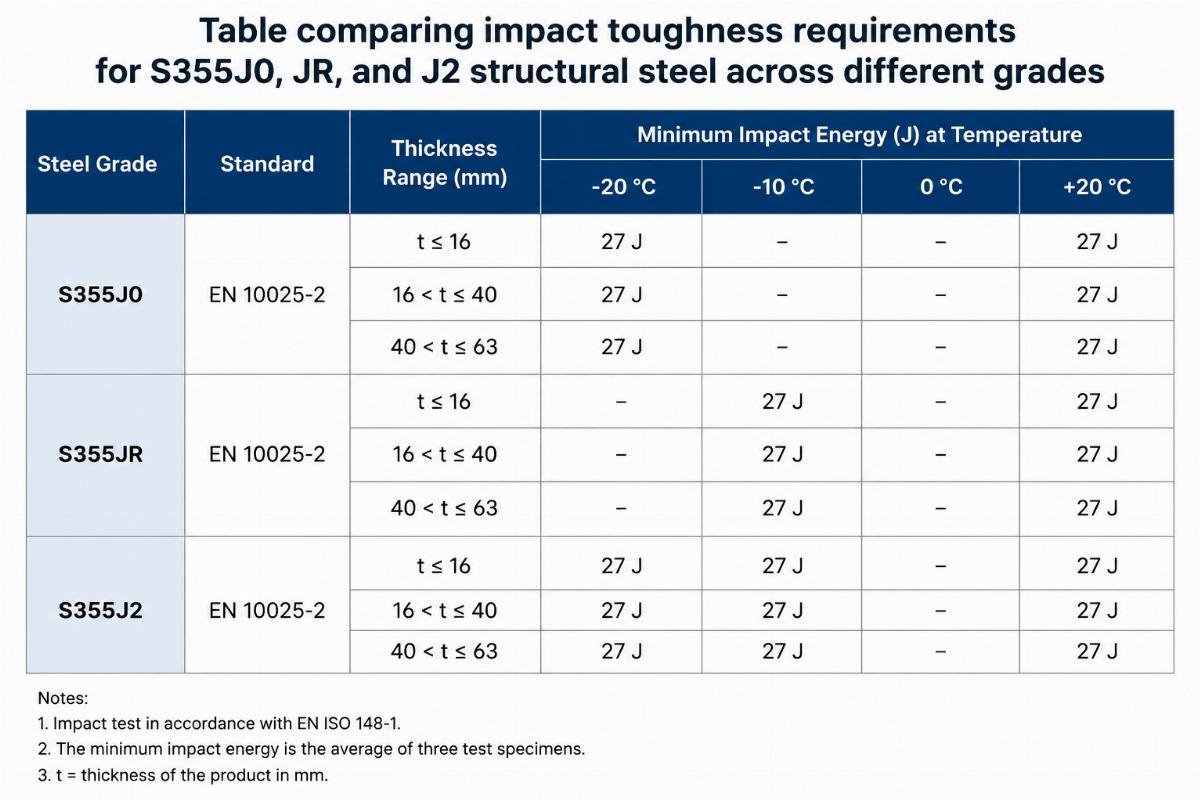
Yield strength determines how much load a structure can bear before deforming permanently. Impact toughness determines how well the material absorbs energy during a sudden shock without fracturing. In static loading scenarios, the difference may seem negligible. However, in dynamic applications such as crane beams, wind turbine towers, or seismic zones, the ability to resist brittle fracture is paramount.
| Grade | Impact Test Temperature | Typical Application Environment | Risk of Substitution |
|---|---|---|---|
| S355JR | +20°C | Indoor structures, temperate climates | High risk in cold weather |
| S355J0 | 0°C | Outdoor structures, seasonal freezing | Moderate risk in extreme cold |
| S355J2 | -20°C | High-latitude, offshore, dynamic loads | Low risk, higher cost |
[NEED_CITE: Mechanical property differences in EN 10025-2 standard]
Consider a case involving a bridge project in a high-latitude region. The engineering design specified S355J2 due to winter temperatures dropping below -15°C. The contractor, seeking cost savings, procured S355J0, assuming the marginal price difference was not justified. During winter commissioning, several components exhibited micro-cracking under vibration loads. The failure was not due to insufficient strength, but because the J0 grade had not been validated for the -20°C threshold required by the actual environmental conditions. The rectification involved replacing entire sections, costing significantly more than the initial premium for J2 material.
This highlights why S355J0 JR J2 structural steel selection must be driven by environmental data and dynamic load analysis, not just budget constraints.
How to Verify EN10219 Certificates for S355 Grades
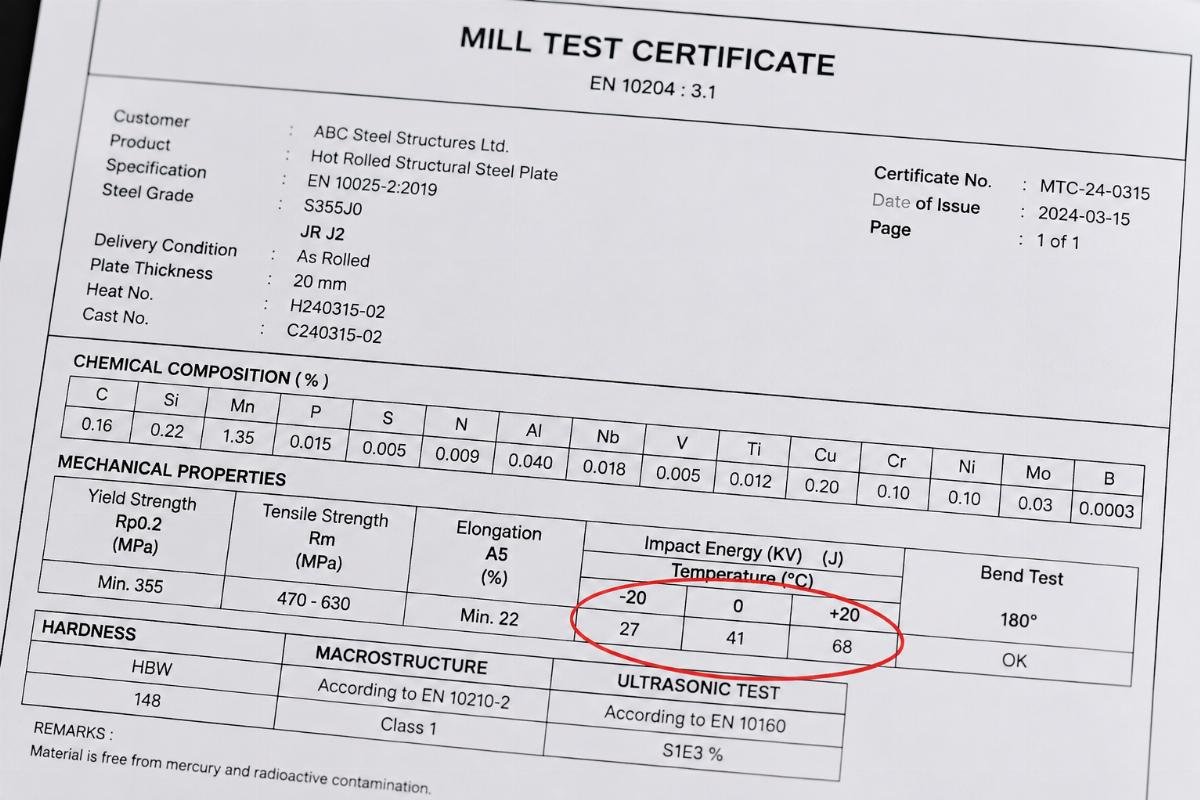
Possessing an EN10219 certificate is necessary but insufficient for verifying compliance. The certificate must be scrutinized line by line to ensure the data matches the ordered grade. Many customs delays occur because the physical goods are labeled correctly, but the accompanying MTC lacks the specific impact test data required for the declared grade.
When reviewing an MTC for S355J0 JR J2 structural steel, focus on the following fields:
- Heat Number Consistency: Ensure the heat number on the physical product markings matches the MTC exactly. A mismatch here is an immediate red flag for mixed batches.
- Impact Energy Values: Look for the column labeled “Impact Energy” or “KV2.” For S355JR, you should see values tested at +20°C. For S355J2, the values must correspond to tests conducted at -20°C. If the certificate only lists room temperature data for a J2 order, it is non-compliant.
- Standard Reference: Confirm the certificate cites EN 10219 for hollow sections or EN 10025-2 for plates/beams. Mixing standards can invalidate the certification for specific structural applications. [NEED_CITE: EN 10219 certification requirements for cold-formed welded structural hollow sections]
In one instance, a shipment of square hollow sections destined for Rotterdam was held for weeks because the MTC listed impact values for J0, while the commercial invoice and packing list declared J2. Although the material itself might have met J2 standards, the lack of documented proof at -20°C meant the customs authorities could not verify compliance. The buyer had to arrange for third-party testing at the port, incurring substantial demurrage charges and delaying the project timeline.
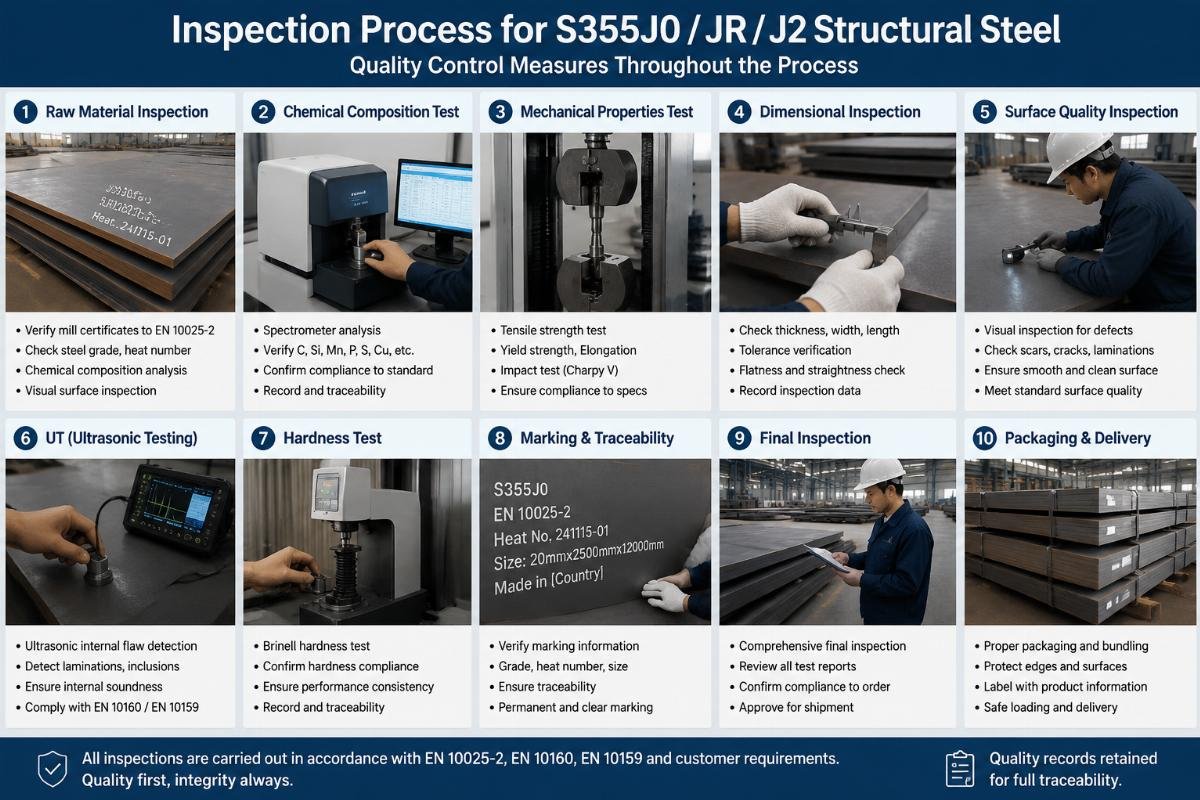
To avoid such pitfalls, reputable manufacturers perform in-house laboratory testing for each batch. At our production facilities, every heat of S355J0 JR J2 structural steel undergoes rigorous impact testing before certification. The data is recorded directly into the MTC, ensuring that the document serves as a verifiable proof of performance, not just a formality. This internal verification process eliminates the guesswork for buyers and ensures smooth customs clearance.
Common Procurement Mistakes and How to Avoid Them
Even experienced buyers fall into traps when sourcing S355J0 JR J2 structural steel. These errors often stem from a lack of alignment between engineering specifications, procurement orders, and quality assurance processes.
Mistake 1: Assuming Interchangeability Based on Price
Buyers often view J0 and J2 as premium versions of JR with no functional difference other than cost. As demonstrated earlier, this ignores the temperature-dependent nature of toughness. Always align the grade with the lowest expected service temperature plus a safety margin.
Mistake 2: Overlooking Thickness Effects
Impact toughness can vary with material thickness. Thicker sections cool slower during rolling, which can affect grain structure. Ensure the MTC specifies impact values for the actual thickness supplied, not just a generic representative sample. [NEED_CITE: Effect of thickness on impact toughness in structural steel]
Mistake 3: Ignoring Surface Treatment Impacts
While surface treatments like galvanizing do not change the base metal’s grade, improper handling during processing can introduce stress concentrations. Verify that the manufacturer’s quality control extends to post-processing inspections, especially for J2 grades used in critical structures.
A European EPC contractor once faced a crisis when a batch of S355J2 beams arrived with minor surface scratches from handling. While superficially acceptable, the lack of detailed inspection records for impact-sensitive areas raised concerns about potential micro-fractures. Because the supplier could not provide granular inspection data linked to specific heat numbers, the contractor rejected the batch. This underscores the importance of choosing suppliers who integrate quality control into every stage of production, from rolling to finishing.
By partnering with manufacturers who prioritize transparency and rigorous testing, buyers can mitigate these risks. Our approach involves maintaining a digital trail of test results for every piece of S355J0 JR J2 structural steel produced, allowing clients to trace performance data back to the specific production batch. This level of detail supports both technical validation and regulatory compliance.
Conclusion
The suffix in S355 steel defines its safety margin in cold and dynamic conditions, not just its strength.
Choosing between S355JR, J0, and J2 requires a clear understanding of impact toughness requirements relative to your project’s environmental and operational demands. Verifying MTCs for specific temperature-based impact data is essential to avoid customs delays and structural failures. Prioritize suppliers who provide transparent, batch-specific certification to ensure your S355J0 JR J2 structural steel meets both engineering and regulatory standards.