
Q235B/Q345B Structural Steel Grade Application Guide
Q345B is not just “stronger” Q235B; it is a fundamentally different material class that dictates structural geometry.
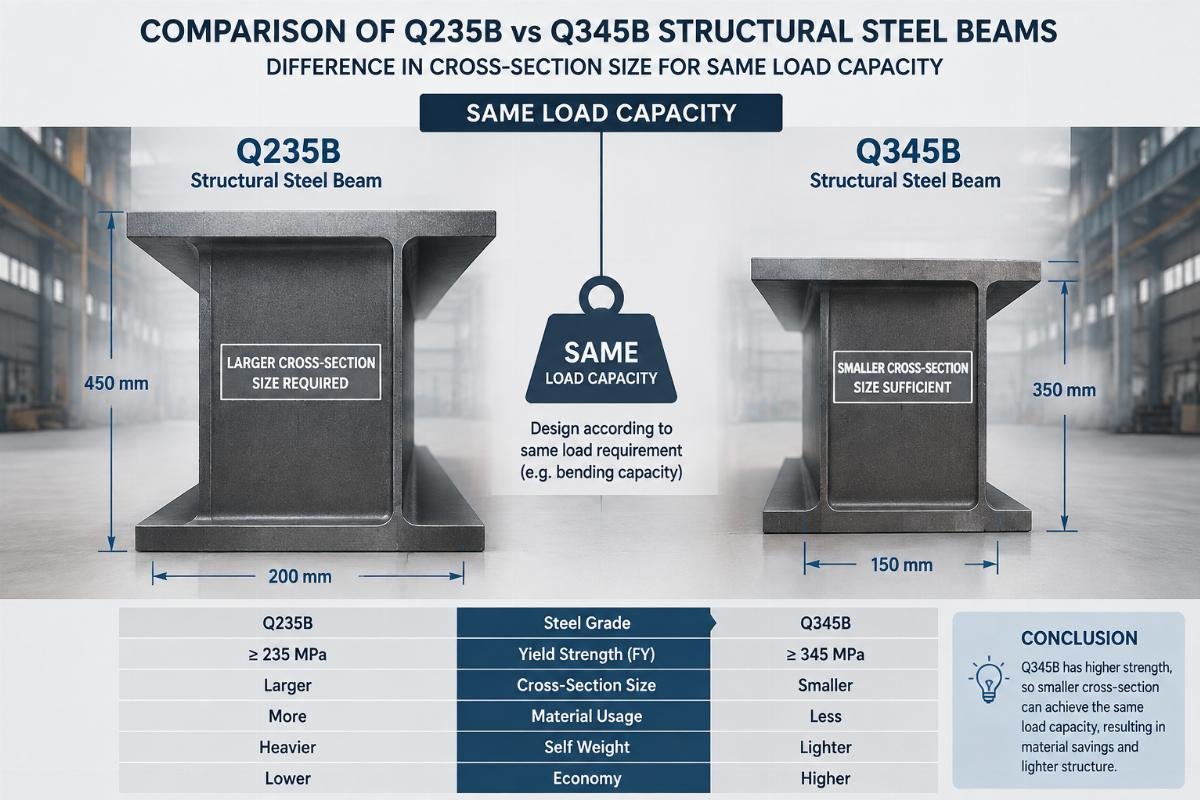
Selecting between Q235B and Q345B structural steel is not a procurement decision based on unit price per ton, but an engineering decision based on yield strength requirements. Q235B, with a minimum yield strength of 235 MPa, is suitable for secondary structures and light-duty frameworks where load ratios are low. Q345B, with a minimum yield strength of 345 MPa, is essential for primary load-bearing elements like long-span beams and heavy columns in warehouses and infrastructure. Substituting Q345B with Q235B to reduce material costs often leads to excessive deflection, requiring costly on-site reinforcement that far exceeds the initial savings. Conversely, using Q345B allows for smaller cross-sections, reducing total steel tonnage and logistics burdens in high-load applications.
The distinction between these two grades defines the safety margin and economic efficiency of any steel structure. Misunderstanding this difference is a common pitfall in emerging markets where cost pressure drives specification changes without engineering validation.
What Are the Key Mechanical Differences Between Q235B and Q345B?
The 110 MPa gap in yield strength is the single most critical parameter distinguishing these grades, dictating their role in structural integrity.
Q235B and Q345B are defined by Chinese national standards GB/T 700 and GB/T 1591 respectively. While they share similar chemical compositions in terms of carbon and manganese ranges, their mechanical properties diverge significantly due to controlled rolling processes and micro-alloying in Q345B. The yield strength represents the stress point at which steel begins to deform plastically. For Q235B, this threshold is 235 MPa for thicknesses up to 16mm. For Q345B, it is 345 MPa for the same thickness range [NEED_CITE: yield strength values per GB/T 700 and GB/T 1591].
This difference means Q345B can withstand approximately 47% more stress before permanent deformation occurs. In practical terms, a beam made from Q345B can carry a significantly higher load than an identical beam made from Q235B, or alternatively, a Q345B beam can be designed with a smaller cross-section to carry the same load as a larger Q235B beam.
| Property | Q235B (GB/T 700) | Q345B (GB/T 1591) | Application Implication |
|---|---|---|---|
| Yield Strength (≤16mm) | ≥ 235 MPa | ≥ 345 MPa | Q345B supports higher loads or allows lighter sections |
| Tensile Strength | 370-500 MPa | 470-630 MPa | Q345B has higher ultimate failure resistance |
| Elongation | ≥ 26% | ≥ 21% | Q235B offers slightly better ductility for forming |
| Impact Test Temperature | +20°C | +20°C | Both require standard room temperature toughness |
| Primary Use Case | Secondary structures, light frames | Primary beams, columns, heavy infrastructure | Selection depends on load bearing requirement |
The tensile strength, which indicates the maximum stress the material can withstand while being stretched before breaking, also favors Q345B. However, elongation is slightly lower in Q345B, indicating it is less ductile than Q235B. This trade-off is acceptable in structural applications where stiffness and strength are prioritized over extreme formability.
Weldability is another crucial factor. Q235B, with its lower carbon equivalent, is generally easier to weld without pre-heating. Q345B, due to its higher strength and potential micro-alloy content, may require pre-heating in thick sections or cold environments to prevent hydrogen-induced cracking [NEED_CITE: weldability guidelines for high-strength low-alloy steels]. This does not make Q345B difficult to weld, but it demands stricter adherence to welding procedures.
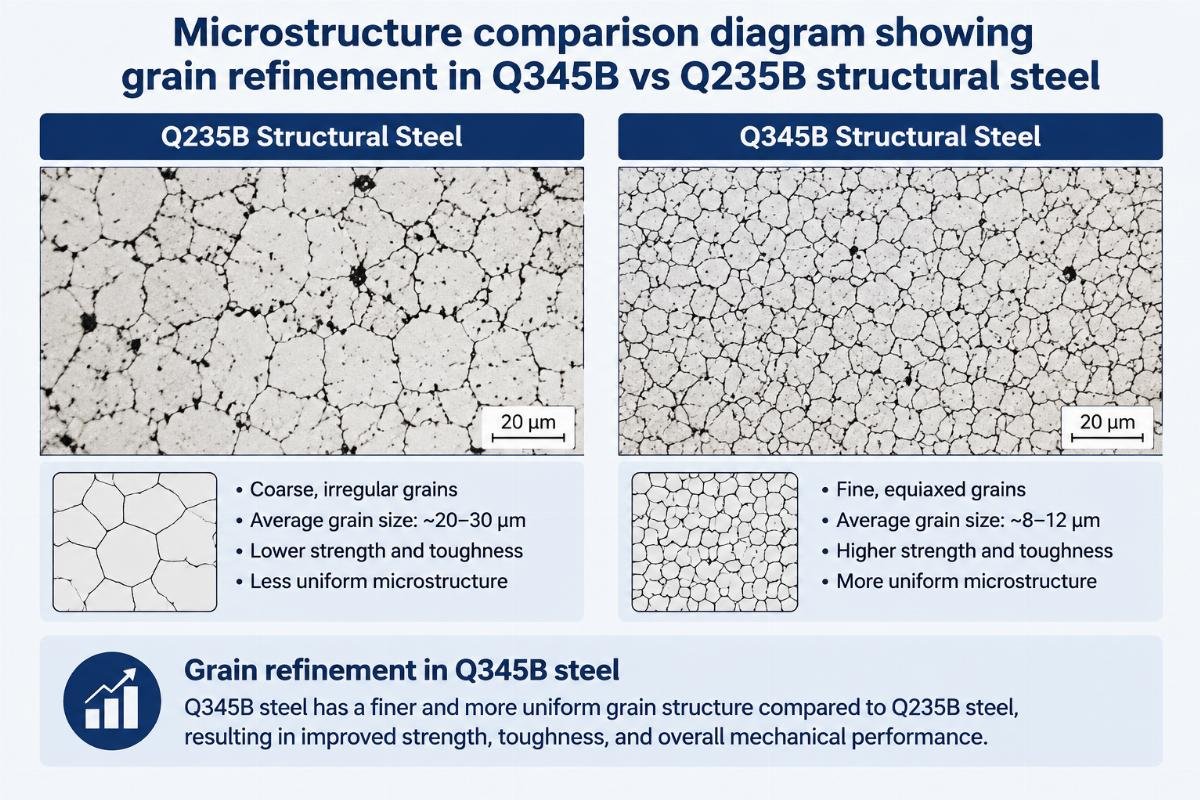
Understanding these mechanical differences is the foundation for correct grade selection. Ignoring them leads to either over-engineering with unnecessary weight or under-engineering with safety risks.
When Should You Choose Q235B Over Q345B?
Q235B is the optimal choice for secondary structures and non-critical supports where cost efficiency and ease of fabrication are paramount.
Not every part of a steel structure requires high yield strength. Using Q345B for every component is a common mistake that inflates project costs without adding value. Q235B is perfectly adequate for applications where the load-to-span ratio is low and deflection limits are not critical.
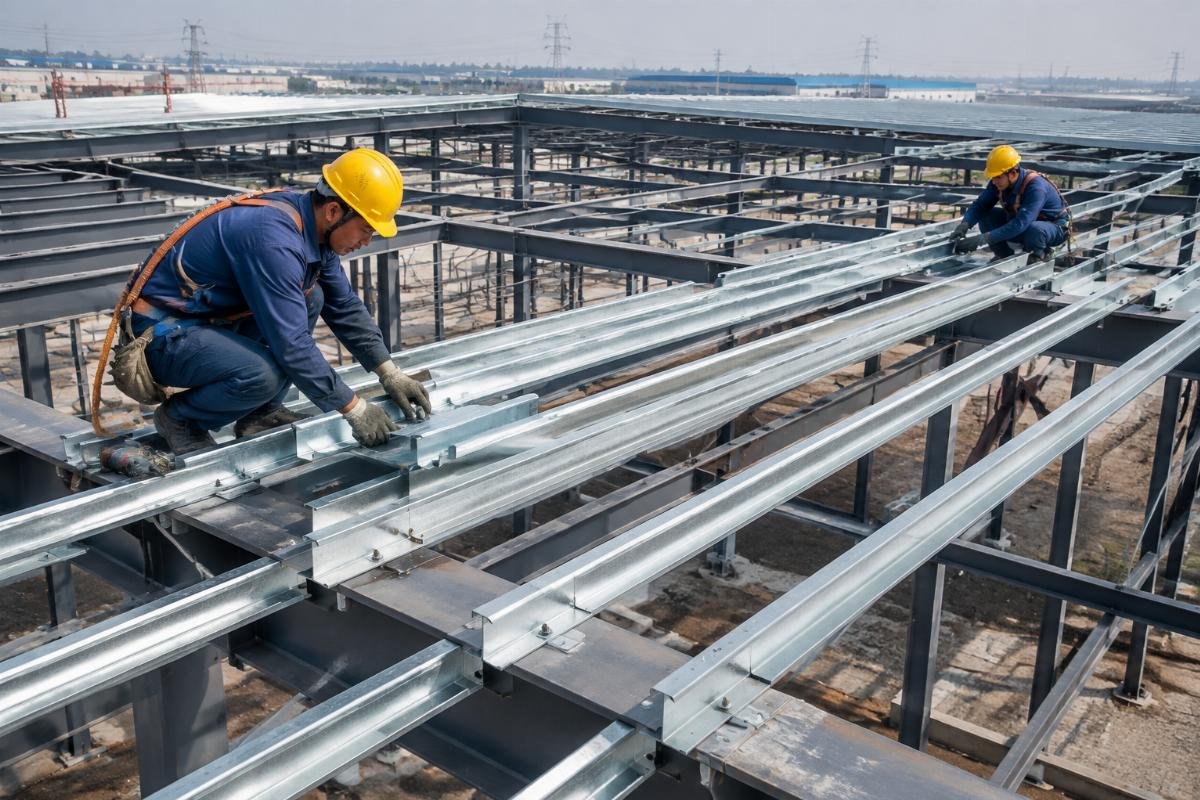
Secondary structural elements such as purlins, girts, bracing, and platform flooring often experience minimal stress compared to primary frames. In these scenarios, the higher strength of Q345B is redundant. A procurement manager in Doha once optimized a large industrial shed project by specifying Q235B for all secondary purlins and Q345B only for the primary columns and rafters. This mixed-grade approach reduced the overall material cost significantly while maintaining structural safety. The key was verifying that the design loads for the purlins did not exceed the capacity of Q235B sections.
Q235B is also preferred for components that require extensive cold forming or bending. Its higher elongation rate makes it less prone to cracking during fabrication. For simple brackets, base plates, and non-load-bearing partitions, Q235B offers a balance of performance and workability.
Furthermore, in regions where welding expertise is limited or where pre-heating equipment is unavailable, Q235B simplifies the construction process. Its forgiving nature regarding welding parameters reduces the risk of joint failure due to procedural errors. This makes it a practical choice for small-scale workshops or remote sites with limited technical resources.
The decision to use Q235B should be driven by engineering calculations, not just habit. If the design allows for the lower yield strength without compromising safety or serviceability, Q235B is the economically superior choice. It avoids the premium price of Q345B where it is not needed.
Why Is Q345B Essential for Heavy-Load and Long-Span Structures?
Q345B is mandatory for primary load-bearing elements to prevent excessive deflection and optimize total steel tonnage in high-stress applications.
In modern construction, especially for warehouses, multi-story car parks, and bridges, spans are increasing while column counts are decreasing. This trend places immense stress on primary beams and columns. Q235B often fails to meet the deflection criteria in these scenarios, even if it technically meets the strength requirements. Deflection, or the degree to which a structural element is displaced under a load, is a serviceability limit state. Excessive deflection can cause damage to cladding, roofing, and internal finishes, and create a perception of instability.
A project in Dubai for a multi-story car park illustrates this point. The initial design used Q235B for long-span beams. The calculations showed that while the beams would not fail, they would deflect beyond the allowable limit under full live load. Switching to Q345B allowed the engineers to maintain the same span with a lighter section, or keep the same section with significantly reduced deflection. The result was a 15-20% reduction in total steel tonnage compared to using oversized Q235B sections to meet deflection limits. This weight reduction offset the higher unit price of Q345B and lowered transportation and installation costs.
Q345B is also critical for columns in multi-story buildings. As the height increases, the axial load on lower columns becomes substantial. Using Q345B allows for smaller column sizes, freeing up usable floor space. In high-rise structures, this space efficiency is valuable. Additionally, Q345B provides a higher safety margin against unexpected overload events, such as seismic activity or impact loads.
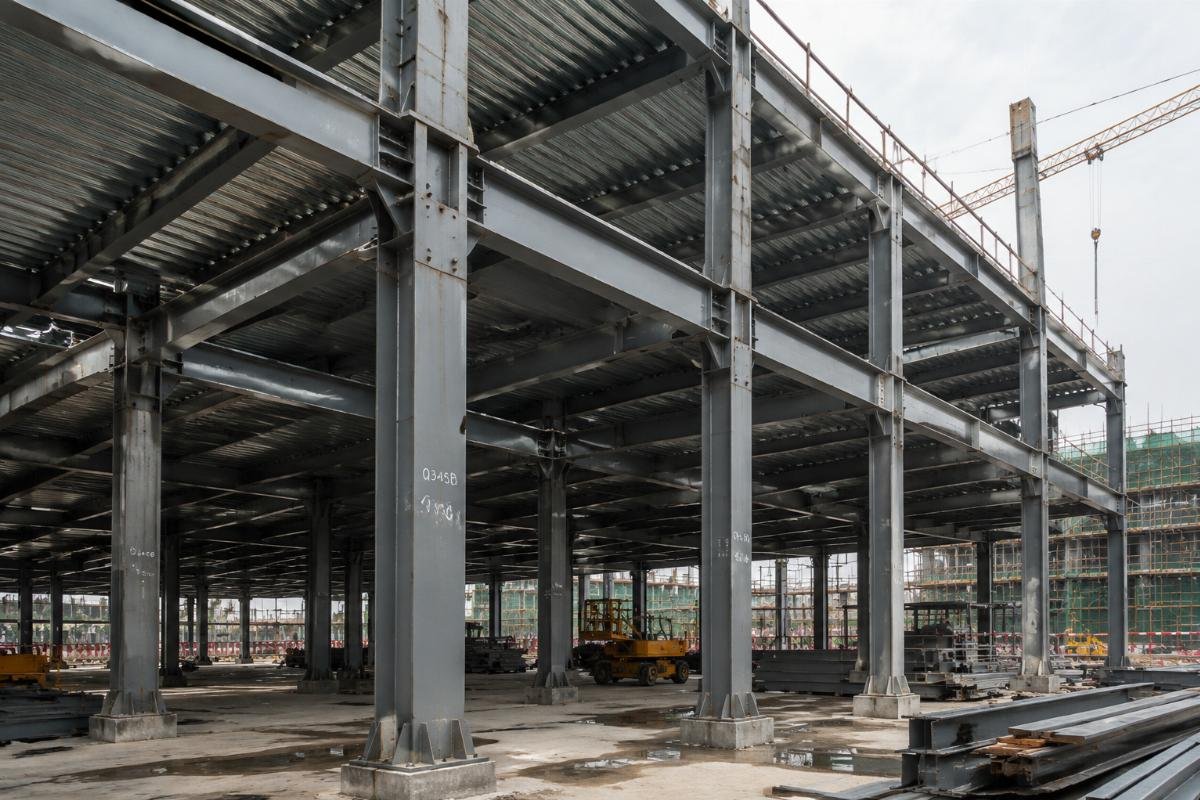
The use of Q345B in heavy-load applications is not just about strength; it is about structural efficiency. It enables designers to create lighter, more open spaces without compromising safety. For any primary frame element subject to significant bending moments or axial compression, Q345B is the standard choice.
How to Avoid Common Selection Mistakes in Procurement?
Verify mill test certificates for yield strength and consult structural engineers before substituting grades to save costs.
The most frequent error in steel procurement is substituting Q345B with Q235B based solely on price, without engineering approval. This happened in a Riyadh warehouse project where the buyer switched main beams to Q235B to save on material costs. During installation, before any additional loads were applied, the beams showed visible sagging. The structure had to be reinforced on-site with additional plates and supports, costing three times the initial savings. This scenario highlights the danger of ignoring yield strength differences.
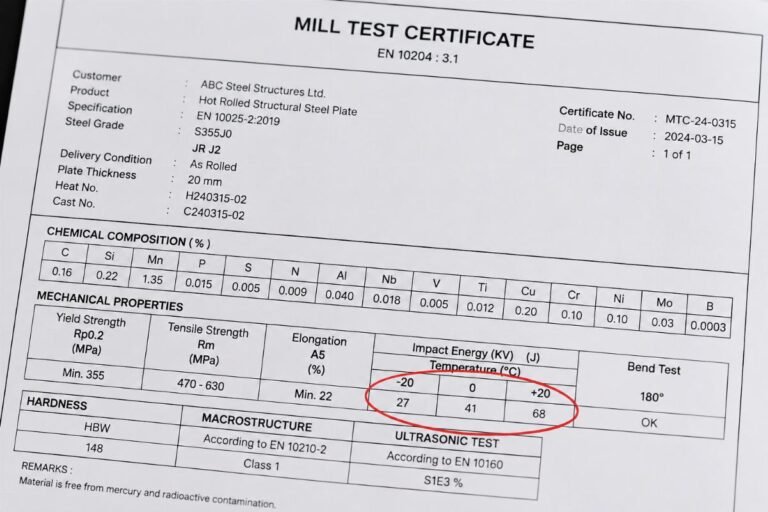
To avoid such mistakes, always request Mill Test Certificates (MTC) that explicitly state the yield strength and tensile strength values. Do not accept certificates that only list chemical composition. The mechanical properties must be verified against the relevant standard. For Q345B, ensure the yield strength is ≥ 345 MPa for the specified thickness.
Another common mistake is assuming that all “structural steel” is interchangeable. Q235B and Q345B have different design strengths in international codes. When converting designs from European standards (S235/S355) or American standards (A36/A572), ensure the correct equivalent is used. Q235B is roughly equivalent to S235JR or A36, while Q345B is comparable to S355JR or A572 Grade 50 [NEED_CITE: cross-reference of international steel grades]. Mixing these up can lead to non-compliance with local building codes.
Engage with the structural engineer early in the procurement process. If cost reduction is a goal, ask if secondary elements can be downgraded to Q235B while keeping primary elements in Q345B. This value engineering approach is safer and more effective than blanket substitution. Also, consider the total cost of ownership, including transportation and installation. Lighter Q345B sections may reduce logistics costs, balancing the higher material price.
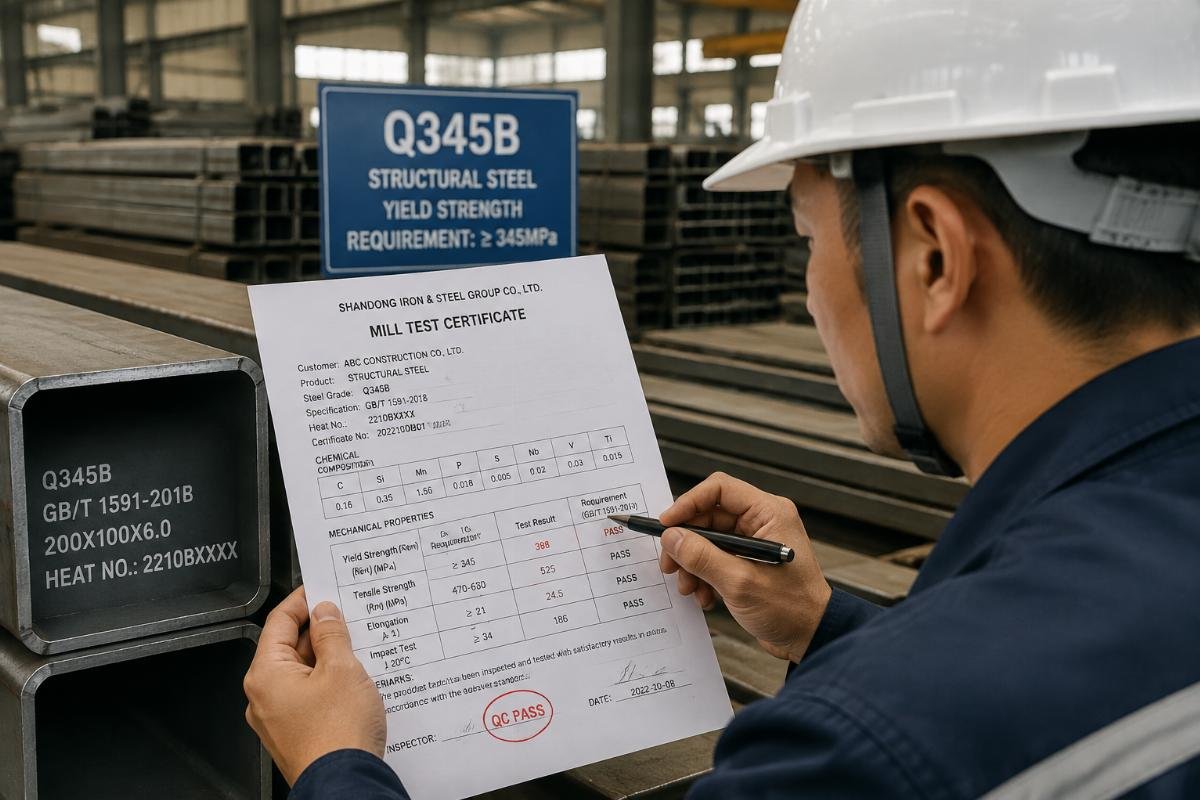
Procurement decisions must be backed by technical data. Relying on price alone ignores the physical realities of structural mechanics. Proper verification and engineering consultation prevent costly rework and ensure project safety.
Conclusion
Correct grade selection balances structural safety with economic efficiency, avoiding both over-engineering and dangerous under-specification.
Q235B and Q345B serve distinct roles in construction. Q235B is ideal for secondary, low-load applications where cost and weldability are priorities. Q345B is essential for primary, high-load structures where strength and deflection control are critical. Understanding the 110 MPa yield strength difference is key to making informed decisions. Always verify mechanical properties through mill test certificates and consult engineering specifications before finalizing material choices. This approach ensures structural integrity and optimizes project costs.