

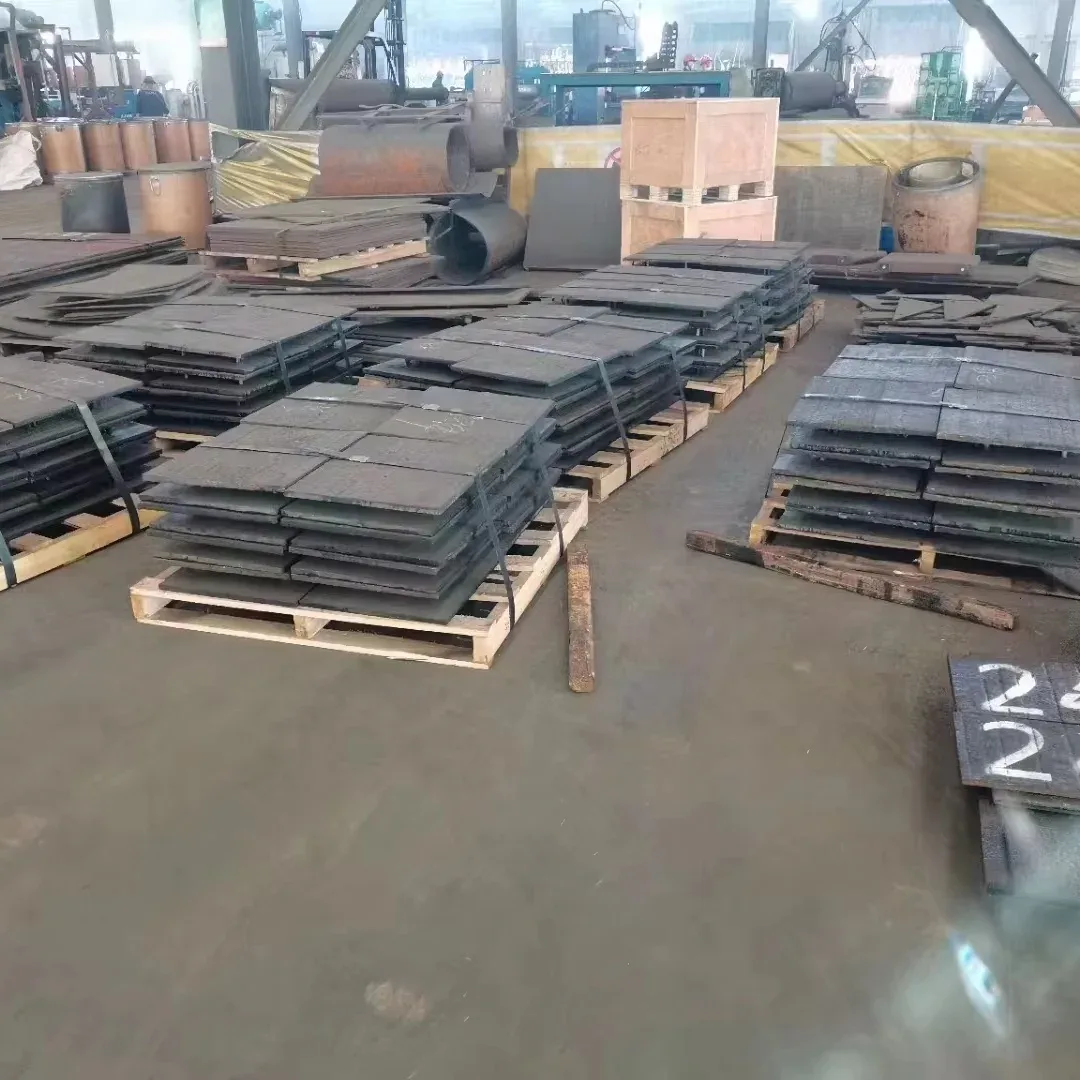


Description
Factory-direct Q690 AR400 wear resistant steel plate supply — every heat tested in our in-house physical and chemical laboratory before release, with full chemical and hardness traceability on the mill test certificate.
Technical Specifications
| Parameter | Value |
|---|---|
| Designation | Q690 / AR400 / Q235 Wear Resistant Hot Rolled Steel Plate |
| Product Type | Steel Plate |
| Steel Grade | Q690, AR400, Q235 |
| Standard | AISI (referenced), meets EN / ASTM equivalence frameworks |
| Section Shape | Flat plate |
| Technique | Hot Rolled |
| Surface Treatment | Hot Rolled |
| Tolerance | ±1% on thickness |
| Application | Construction, Petrochemical, Machinery, Bending and Welding Fabrication |
| Origin | Shandong, China |
Application Suitability
| Industry | Typical Applications |
|---|---|
| Machinery Manufacturing | Excavator buckets, crusher liner plates, conveyor scraper blades |
| EPC Contractors & Construction | Heavy equipment base frames, industrial flooring, structural support brackets |
| Petrochemical | Pressure vessel shell plates, platform grating, pipe rack supports |
| Mining & Aggregates | Hopper liners, chute wear plates, screen deck panels |
Where Hardness Traceability Decides Whether a Crusher Liner Survives the First Quarter
A mill certificate that only lists chemistry without verified Brinell hardness is a liability on any wear-resistant plate order.
When Q690 AR400 wear resistant steel plate arrives at a remote aggregate plant and the on-site hardness test falls below the expected range, the liner plates wear through in weeks instead of months. The replacement cost is not just the steel — it is the air-freight, the shutdown window, and the re-welding labor. Third-party inspectors flagging inconsistent hardness against the declared grade can hold an entire container at customs, turning a procurement exercise into a project delay. [NEED_CITE: EN 10204 inspection document types for steel plate verification]
Matching Wear-Resistant Grades to High-Stress Fabrication Environments
Selecting the right grade from Q690, AR400, or Q235 depends on whether the primary demand is abrasion resistance, structural load-bearing, or weldability for field modification. Q690 AR400 wear resistant steel plate is specified where material loss from impact and sliding abrasion is the dominant failure mode — crusher liners, excavator bucket edges, and hopper walls. The hot-rolled surface condition accepts field welding without additional pre-treatment, while the ±1% thickness tolerance ensures consistent fit-up when plates are machined or flame-cut to non-standard profiles. Our in-house laboratory tests every heat for both chemical composition and Brinell hardness before the plate leaves Jinan, so the certificate matches the physical material your welders receive on site.
Engineering Compliance and Certification for Project Acceptance
Wear-resistant plate used in structural or pressure-containing applications must comply with the governing project specification — whether that is EN 1993 for European steel structures, AISC for North American projects, or client-specific material requisites for petrochemical fabrication. The Q690 AR400 wear resistant steel plate we supply is produced under ISO 9001:2015 quality management, and third-party inspection through SGS or BV is available before shipment to verify hardness, chemistry, and dimensional tolerance against the purchase order. For EU-bound projects, CE documentation and EN standard equivalence statements support customs clearance and engineer approval. [NEED_CITE: steel grade equivalence mapping between Chinese GB and international EN/ASTM standards]
Steel Grade Selection and Hot-Rolled Process Fundamentals
Q690 is a high-strength low-alloy structural steel designed for heavy load-bearing applications where yield strength and weldability must coexist. AR400 is an abrasion-resistant grade where through-thickness hardness uniformity determines service life in sliding-wear environments. Q235 serves as a general structural grade for non-wear-critical frames and supports. The hot-rolling process produces a mill scale surface that is suitable for most fabrication environments; for applications requiring bare metal exposure or coating adhesion, pickled and oiled or blast-cleaned conditions can be specified. Thickness tolerance of ±1% on hot-rolled Q690 AR400 wear resistant steel plate ensures that CNC-cut profiles maintain dimensional accuracy without secondary machining. [NEED_CITE: hot rolling process effects on mechanical properties of wear-resistant plate]
The Hidden Cost of Unverified Hardness on Wear Plate Orders
Ordering wear-resistant plate on price alone, without requiring verified hardness testing from an independent laboratory, shifts the risk entirely onto the buyer. A plate that meets chemistry on paper but falls short on Brinell hardness will fail prematurely in abrasion service — and the failure often occurs after installation, when replacement means dismantling welded assemblies and shutting down production. Certification gaps compound the problem: without EN 10204 Type 3.1 or 3.2 test certificates tied to specific heat numbers, project engineers cannot approve the material, and customs authorities in strict-import markets may reject the shipment. [NEED_CITE: consequences of missing mill test certificates on steel plate customs clearance]
Why Procurement Teams Source Q690 AR400 Wear Resistant Steel Plate From Us
Every plate we ship is tested in our own physical and chemical laboratory — not outsourced, not assumed from the mill’s paperwork. This is the same lab capability that supported our development of 41 patented steel product technologies, including proprietary processes that have filled specification gaps in international markets. We hold 2,800+ stock specifications across plate, tube, and section categories, meaning your wear plate order can be consolidated with structural beams and welded hollow sections in a single shipment — reducing coordination overhead and freight cost. CE certification under EN 10210/EN 10219, ISO 9001:2015 registration, and SGS/BV third-party verification are standard, not optional extras. Custom non-standard thickness, width, and length are available for projects requiring specific cut-to-size profiles. Professional loading plans optimize container weight distribution for heavy plate, and door-to-door logistics cover 50+ countries including EU, North America, Southeast Asia, and the Middle East.
Documentation & Compliance
- Mill Test Certificate documenting Q690 / AR400 / Q235 chemical composition and Brinell hardness per heat number, issued under EN 10204 Type 3.1
- CE certificate confirming conformity with EN 10210 / EN 10219 for steel plate and structural hollow section applications in EU markets
- ISO 9001:2015 quality management system certificate covering hot-rolled plate production and inspection processes
- SGS or BV third-party inspection report verifying hardness, dimensional tolerance, and surface condition before shipment
- Full material traceability by heat number from slab to finished plate, supporting project-specific quality audits
- Customs documentation package including packing list, Bill of Lading, and Certificate of Origin for destination-country clearance
Packaging, Loading & Delivery
- Hot-rolled Q690 AR400 wear resistant steel plate bundled with high-tensile steel strips and edge protectors to prevent coating damage and edge deformation during ocean transit
- Surface protection via mill oil coating on hot-rolled finish to prevent transit corrosion without interfering with subsequent welding or coating processes
- Container loading plans optimized for heavy plate weight distribution, maximizing payload per 20ft or 40ft container while respecting port crane capacity limits
- Cut-to-length and custom width service available for Q690 / AR400 / Q235 plate, reducing on-site cutting waste and welding preparation time
- Each plate marked with heat number, steel grade, and thickness for on-site traceability verification against the mill test certificate
- FOB, CIF, and DDP shipping terms available with real-time tracking to ports across EU, North America, Southeast Asia, Middle East, and Africa
Start Your Q690 AR400 Wear Resistant Plate Inquiry
Submit your specification sheet — including steel grade, thickness, width, length, quantity, and destination port — and receive a detailed quotation with delivery timeline and applicable certification documents within 12 hours. For non-standard profiles or project-specific hardness requirements, our technical team will provide a custom production assessment based on your application environment.
Request a Quote with Mill Test Certificate
Send your Q690 AR400 Q235 wear resistant steel plate specifications to admin@sdxjysteel.com or contact us via WhatsApp at +86 188 5315 7756 for factory-direct pricing and certification confirmation.
Frequently Asked Questions
Q: What is the difference between Q690, AR400, and Q235 for wear-resistant applications?
A: Q690 is a high-strength low-alloy structural grade combining yield strength with weldability. AR400 is a dedicated abrasion-resistant grade where through-thickness hardness determines service life. Q235 is a general structural grade for non-wear-critical applications. Selection depends on whether the primary failure mode is abrasion, structural overload, or a combination.
Q: Can I request third-party inspection before shipment?
A: Yes. SGS and BV third-party inspections are available for Q690 AR400 Q235 wear resistant steel plate orders. The inspection covers hardness testing, chemical composition verification, dimensional tolerance, and surface condition against the purchase order specification.
Q: Do you provide non-standard thickness and cut-to-size plates?
A: Yes. Custom thickness, width, and length are available for hot-rolled wear-resistant plate. Our production capability covers over 2,800 specifications, and non-standard profiles can be produced to reduce on-site cutting waste for your fabrication.
Q: What documentation is provided for customs clearance and project approval?
A: Every shipment includes a Mill Test Certificate with heat number traceability, packing list, Bill of Lading, and Certificate of Origin. CE certification and EN standard conformity statements are available for EU-bound orders. Third-party inspection reports from SGS or BV can be arranged before loading.
Q: What is the surface condition of the hot-rolled plate?
A: The standard surface condition is hot-rolled with mill scale. For applications requiring bare metal exposure or improved coating adhesion, pickled and oiled or blast-cleaned conditions can be specified at the time of order.
Get Factory-Direct Pricing on Wear-Resistant Plate
Email your Q690 AR400 Q235 wear resistant steel plate requirements to admin@sdxjysteel.com or message +86 188 5315 7756 on WhatsApp to receive a quotation with mill test certificate and delivery schedule.